
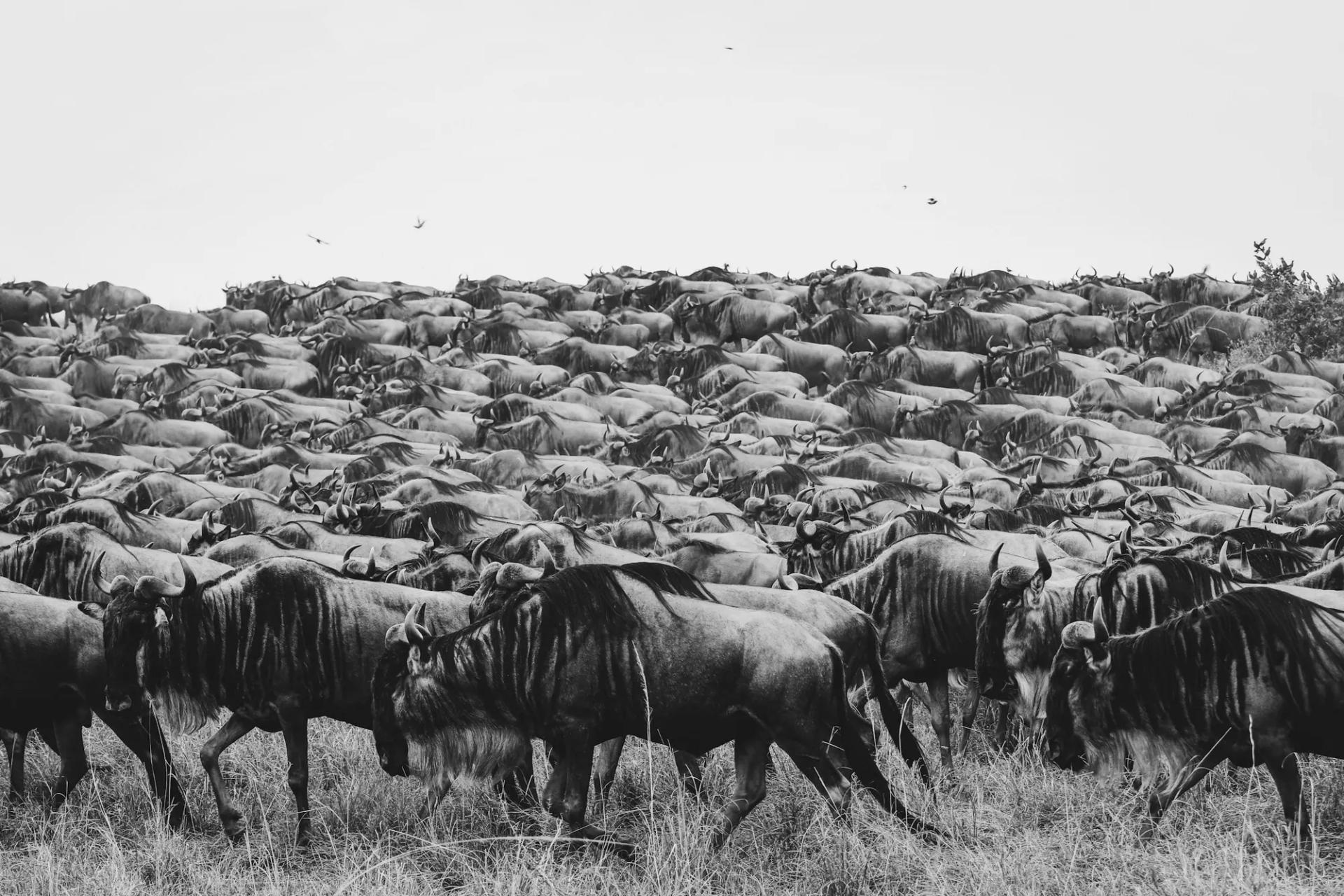
The Great Migration is not a single event. It is a continuous loop of more than 1.5 million wildebeest, with zebra and gazelle, through the Serengeti in Tanzania and the Maasai Mara in Kenya, following the rain and fresh grass. Where you should stay depends entirely on your travel month.
The pattern below is typical. Each year the rains shift it by a few weeks, so we confirm camp locations closer to your dates.
| Month | Where the herds usually are | What's happening |
|---|---|---|
| January | Southern plains: Ndutu, Kusini, Naabi | Calving begins |
| February | Ndutu and Kusini | Peak calving – thousands born each day; strong predator activity |
| March | Ndutu–Kusini, some towards Maswa | Last calves; rains begin late month |
| April | Southern and central plains | Long rains; herds start north at month end |
| May | Moru Kopjes towards the Western Corridor | Long columns on the move |
| June | Western Corridor and Grumeti Reserve | Grumeti River crossings possible |
| July | Front reaches Kogatende, northern Serengeti | Mara River crossings usually begin |
| August | Northern Serengeti, Lamai Wedge | Frequent Mara River crossings |
| September | Northern Serengeti and Mara | Crossings in both directions |
| October | Northern Serengeti, moving to Lobo | Last crossings back from Kenya |
| November | Lobo to central Serengeti | Herds moving south with the short rains |
| December | Central Serengeti to Ndutu | Arriving back on the calving grounds |
Calving season (December–March)
The herds gather on the short, mineral-rich grass of the southern plains. In February, hundreds of thousands of calves are born within a few weeks. Lion, cheetah and hyena hunt across the open plains, and the light is clear after the rains. It's less crowded than the northern crossings and very good for photography.
River crossings (July–October)
The Mara River crossings are the scenes you've seen on television: herds plunging down steep banks past crocodiles. They are unpredictable. Herds may wait at the bank for hours or days, so patience – and time in the area – matters more than anything.
How to plan
- Choose your month first, then the area. We base you in the right seasonal camp.
- Allow two full days with the herds.
- Book early for July–September: the best-placed camps fill 9–12 months ahead.
- Consider flying between the northern Serengeti and Arusha to save a long drive.
See our 7-day Great Migration safari.
FAQ
How many animals are in the Great Migration?
More than 1.5 million wildebeest, together with about 250,000 zebra and several hundred thousand gazelle.
Can you guarantee a river crossing?
No. Herds can gather at the riverbank for days and then cross while you're elsewhere. Spending two or more full days in the right area gives you the best chance.